

|
June 5, 2003
Should Playwrights Direct Their Own Work?
Elias Stimac interviews director and author Russell Reich
Excerpts from the following interview appeared in the May 30 - June 5 2003 issue of BACK STAGE and on ENTERTAINMENT TONIGHT ONLINE 1. Can you describe your process for directing a new work? I begin with having the playwright read the play to me. The writer's intimate knowledge of the play will inform the reading and address questions that might otherwise baffle me for days. I ask questions, either to the writer or myself: Where did the idea come from? What is its major conflict? What do the characters want? Who is chasing whom? Where's the resistance? What are the obstacles? How do the characters feel about each other? What is the central question, the basic "will she or won't she...?" that will keep the audience engaged and interested? If I feel any of these key elements is confusing or lacking, I'll discuss it with the writer, as well as identifying the play's strenghts. During rehearsals, I try to keep in mind that the story and the characters are the creations of writer and the actors, so I'm not the parent of any of this. As director, I'm more like the obstetrician -- or the midwife as Stanislavsky described it. And like a physician, I have to know the right questions to ask, and when to intervene clinically if I sense something's awry. Generally I try to keep out of the way the rest of the time and do as little harm as possible.On the other hand, I also believe it's necessary for any director, before ever stepping into the rehearsal room, to have a very clear idea of what he or she wants to accomplish and bring to the work, and what the audience should experience as a result. What's my intention in being there? What can I give to this work? At those times when I didn't have a clear and compelling answer to this question, I learned that I really didn't have a right to be in the room with other artists at all. Writers and actors and designers all have a right to expect from a director a clear sense of what we're all there to accomplish. What's the play about? What impact should it illicit? How does it go about working its magic? Are our choices consistent with that idea or not? As director, I have the responsibility to know the answers. I have the option to change my mind; I don't have the option to have no opinion. 2. Do you always/usually/never prefer to direct original plays? I have no preference, which is not the same as sensing no difference. There's a huge difference between directing the umpteenth production of The Tempest or Peer Gynt on the one hand, and a new work that's never been tested or explored on the other. Original plays carry the unique responsibility of a proper birth. I could hardly kill Hamlet no matter how dreadfully I might direct it, but my work on a new play can harm that play forever. That enormous accountability also carries with it the potential for an enormous reward; the chance to make the one and only first impression would be appealing for almost any director. And original works are more likely to benefit from the unique presence of a living writer. This provides the director with some opportunity to work with the writer to influence the actual words and shape the script. What new works necessarily lack is a legacy of performance, a reservoir of interpretation that I can chose to tap into, build upon, or rebel against. With proven works, I become part of an historical stream, and I feel like I'm in a partnership with all those who took on the same journey, the same exploration. That is its own reward, distinct from directing something new. 3. In your opinion, what is the playwright's role during rehearsals? Like a policeman, the playwright is there to serve and to protect. The biggest challenge is knowing when to do one or the other. The writer needs to serve in the sense that once the words are on the page, they are no longer the writer's words alone, they are read by others, interpreted through them, and re-delivered to yet more people. The play cannot be merely what the writer had in mind; he or she must be willing to sacrifice the limited personal vision in order to arrive -- with luck and the passion, experience, and skill of others -- at something greater. Presumably, writers need actors to do what writers cannot, to breathe life into the characters, to make choices with the language and to translate language into actions; writers presumably need directors to lead the others as a team to bring the words to life through every available medium and nuance. And so on with the others, each making a unique contribution commensurate with their responsibilities. Therefore the writer, in rehearsal, is there to serve others, to clarify intentions and meaning. This is properly done through the director, or, with the director¹s permission and supervision, directly to the actors or designers. Contrariwise, a playwright who merely serves others does the play and the audience a disservice. I'm a big believer in the integrity of the creative mind, working in quiet, passionate isolation. Good writing originating from a single source has an integrity that others -- not as personally skilled, invested or driven to bring to life -- can easily damage. For the writer, then, I imagine rehearsal is like watching others raise your child. If the writer sees that the child is being reared in a manner contrary to its nature, the writer has an obligation to speak up, intervene, and protect the core idea, the core experience he or she intended for the audience. Sure, it might get contentious, but it's what any good parent would and must be prepared to take on. 4. At what point in the rehearsal/preview process should the writer stop making script changes? This is a matter of personal directing technique. My experience is that it's a fairly obvious and natural moment when the script has moved out of the purview of the writer and into the mouths and bodies of the actors. My tendency is to allow this to happen. It occurs well after the actors are off-book but usually before a late dress rehearsal. Script changes past this point can seem intrusive or annoying to the actors, and can even cause some damage to a performance. Actors and directors do a lot of internal thinking and working that may not be apparent to the writer, and changing words past this point may have bigger implications than the writer may realize. The actors' adaptation to new lines or recovery to former confidence may take longer than expected, perhaps it may never happen. That's why I'm not an advocate of tinkering indefinitely. On the other hand, I've occasionally seen others work in precisely the opposite fashion quite productively. It strikes me as a bit like "Every Man for Himself!" as new script pages are distributed hourly, but I suppose this high wire act injects some excitement into the undertaking and keeps everyone on their toes. Or sometimes it's simply necessary to tinker when opening night is 48 hours away and disaster looms otherwise. Those emergency situations, though, are almost always the result of some earlier failure that wasn't dealt with properly at the time. That's my sense, anyway. My preference is to set the script and refine from there rather than try to reach perfection in the language at the risk of everything else. I think it's good for the writer to understand that, to some degree, you never really finish, you simply stop at the appropriate moment. 5. What advice would you give to a playwright who wants to direct his/her own work? I understand why you want to do it -- and it's not your fault -- but don't. You are probably not equipped. While there is some overlap in a writer's storytelling skill and a director's, in general they are vastly different jobs. One activity is solitary, the other collective; one primarily language-based, the other of more broad interest. If you want to direct your own work, first ask yourself if you're doing it for merely negative reasons ("I can't find a director I trust"), or if you have positive ones as well. Do you have legitimate reasons to believe you are skilled as a teacher, therapist, visual artist, orator, coach, parent, professor, and captain? All those skills rarely reside in one person, but each will be required at some point if you choose to direct.Also ask yourself: Will I be able to lose my preconceptions and let talent do what it does? Will it be difficult for me to allow or even encourage the others to take my work and make it their own? Finally, before you take the directing plunge: Can you identify successful productions written and directed by the same person? It's not that they don't exist, but if you can't identify them, you may be lacking in role models to get the job done well. I know you're still going to want to direct your own work, so at least read some good books on the topic before you do it. The best, I think, are A Sense of Direction (William Ball), On Directing (Harold Clurman), Notes on Directing (Frank Hauser and myself), and Picture This (Molly Bang). Jon Jory's new book, Tips: Ideas for Directors, is also quite useful. 6. What advice would you give to a playwright who does not direct his/her own work? My advice is to do what the director should do, but probably won't: Clarify exactly how the two of you are to interact. Ask the director: How do you see the play? How do you see the characters and what type of actors do you think would best play them? What are your rehearsal rules? When should I come to rehearsal? Where should I sit? When is it best to stay away from rehearsals? How should we exchange ideas? How often should we speak? Do you prefer moment-by-moment notes, hourly emails, nightly telephone talks, or weekly lunches? When and how should I speak to the cast? How will we handle changes to the script? If you want to avoid major mistakes, you need to agree on all these things before rehearsals begin. 7. What additional advice would you give to a director who stages someone else's script? Listen to the playwright! When the writer has a note for you, it is frequently accompanied by a slight sense of trepidation -- a reluctance to disrupt or disturb you or the work. A playwright's note finds its way to you, then, despite these obstacles and out of an overriding conviction that it still needs your attention. So pay attention. |
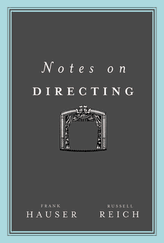 “Book of the Year” Winner of ForeWord Magazine's 2003 silver award |
|
 RCR Creative Press
Notes on Cooking
Notes on Directing
Home
Praise
Bios
Media Room
Recommended
Contact
RCR Creative Press
Notes on Cooking
Notes on Directing
Home
Praise
Bios
Media Room
Recommended
Contact